To see more detail select the image and zoom in. Select outside the image to restore the initial view.
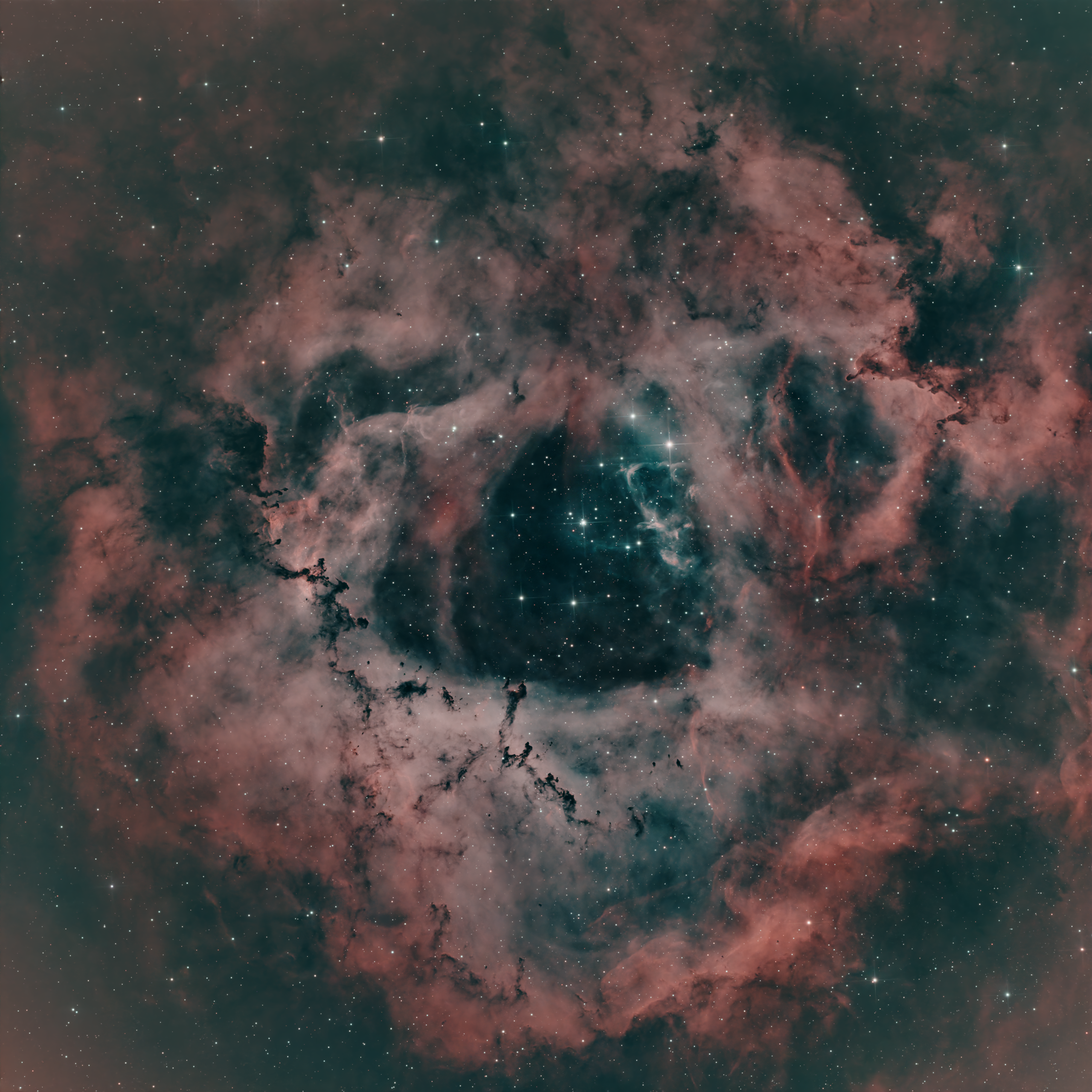
NGC2237, THE ROSETTE NEBULA on 2025-11-24,25,26
The Rosette Nebula (Also known as Caldwell 49) is an H II
region located near one end of a giant molecular cloud in the Monoceros region
of our Milky Way Galaxy. The open cluster NGC 2244 (Caldwell 50) is closely
associated with the nebulosity. The stars of the cluster having been formed from
the nebula's matter. The cluster and nebula are approximately 5,000 light-years
from Earth and measure roughly 130 light years in diameter. The radiation from
the young stars excites the atoms in the nebula, causing them to emit radiation
themselves producing the emission nebula we see. The mass of the nebula is
estimated to be around 10,000 solar masses. A survey of the nebula with the
Chandra X-ray Observatory has revealed the presence of numerous new-born stars
inside the Rosette Nebula.
Approximately 2500 young stars lie in this star-forming complex, including the
massive O-type stars HD 46223 and HD 46150, which are primarily responsible for
blowing the ionized bubble. This photo was taken in Kyle, Texas through a 6-inch
f/4 Telescope, on a ZWO AM5 mount, with a ZWO ASI533MC PRO color camera plus a
dual-band Ha-O III filter. The processing was done in PixInsight. The total
image acquisition time is: 9 hours 48 minutes 00 Seconds.
Previous, Older Photo

NGC2237, THE ROSETTE NEBULA on 2023-11-21
This photo was taken in Kyle, Texas through a 6-inch f/4 Telescope, on a Sky-Watcher EQ6-R mount, with a ZWO ASI533MC PRO color camera plus an Optolong L Pro Light Polution Filter. The total image acquisition time is: 04 hrs 15 min 00 sec.